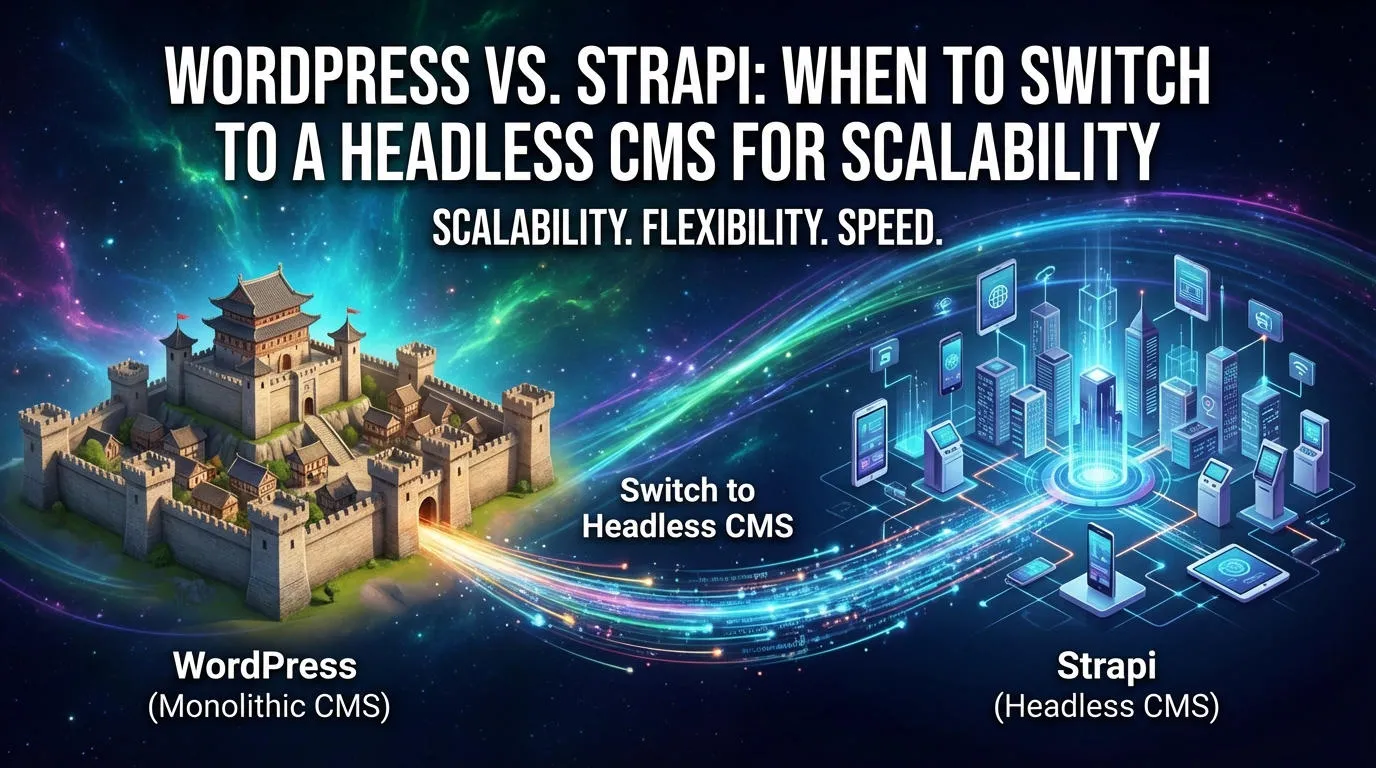
For years, WordPress has been the undisputed king of Content Management Systems (CMS). Its ease of use, vast library of plugins, and low barrier to entry make it the go-to choice for websites of all sizes.
However, as digital experiences become more complex—requiring content distribution across multiple platforms, massive scalability, and seamless integrations—many organizations are discovering the limitations of traditional, monolithic CMS architecture.
This is where the shift to a headless CMS like Strapi becomes a strategic imperative.
Key Takeaways
- Architecture: WordPress couples the backend and frontend; Strapi decouples them for flexibility.
- Scalability: Headless CMS architectures handle heavy traffic and complex integrations more efficiently than monolithic setups.
- Security: Decoupling the frontend reduces the attack surface compared to plugin-heavy WordPress sites.
Monolithic vs. Headless: Understanding the Core Difference
A headless CMS separates the content management backend (the “body”) from the presentation layer (the “head”), allowing developers to distribute content anywhere via API. The question isn’t if you should consider a headless approach, but when the limitations of WordPress outweigh its familiarity.
The following table breaks down how a monolithic CMS compares to a headless architecture:
| Feature | WordPress (Monolithic CMS) | Strapi (Headless CMS) |
|---|---|---|
| Architecture | Coupled (Backend + Frontend together) | Decoupled (Backend content via API) |
| Content Delivery | Primarily via built-in theme/templates | Via API (REST/GraphQL) to any device |
| Scalability | Can be challenging with heavy traffic and plugins | Highly scalable, content API is fast and efficient |
| Technology Stack | PHP/MySQL, tightly coupled to themes | Node.js, allows any frontend (React, Vue, etc.) |
| Best For | Blogs, small business sites, rapid deployment | Multi-platform content, high traffic, complex integrations |
When Should You Switch from WordPress to Strapi?
Switching from a familiar system like WordPress is a big decision. Here are the key indicators that signal it’s time to explore a headless solution like Strapi for greater scalability and flexibility:
1. You Need True Multi-Channel Content Delivery
If your business needs to publish content not just on a website, but also on mobile apps, smart displays, kiosks, or other devices, WordPress’s tight coupling to its presentation layer becomes a liability. A headless CMS excels here by serving content purely as data, making it universally consumable.
2. Performance and Load Times Are Suffering
As WordPress sites grow, with more plugins, larger databases, and complex themes, the site speed often plummets. This directly impacts SEO and user experience. Headless architecture allows you to use modern, blazing-fast frontend frameworks (like Next.js or Gatsby) which can deliver performance far superior to most traditional WordPress setups.
3. Your Security Concerns are Increasing
A monolithic CMS with a large ecosystem of third-party plugins inherently creates a wider attack surface. By decoupling the backend and frontend, and using a modern API-driven approach, a headless CMS can significantly enhance security.
4. You Require a Modern, Specialized Tech Stack
Modern development teams want to use the latest, fastest technologies (like React, Vue, or Angular). WordPress forces the use of a PHP-based stack. Strapi, built on Node.js, gives developers the freedom to choose the best technology for the frontend, leading to more maintainable and powerful applications.
Case Study: The Scalability Success of TwinSpires
The challenges of a monolithic CMS were clearly illustrated in the case of TwinSpires, a premier platform for horse racing and sports betting.
- The Challenge: TwinSpires was running a traditional, coupled CMS that struggled to keep pace with high traffic. The monolithic structure made rapid feature deployment difficult and limited their ability to scale during peak events.
- The Solution: We migrated TwinSpires to a headless CMS architecture to provide the necessary separation and speed.
- The Results:
- Massive Scalability: The decoupled architecture allowed the site to handle extreme traffic fluctuations.
- Speed and Reliability: Content delivery was optimized for real-time data.
- Developer Agility: The new architecture provided flexibility to deploy specialized frontend experiences without disrupting the core CMS.
The full details of this successful transition can be reviewed in the case study provided here: TwinSpires Case Study.
Frequently Asked Questions (FAQ)
Is Strapi better for high-traffic websites? Yes, Strapi is highly scalable because the content API is fast, efficient, and decoupled from the frontend presentation layer, making it ideal for high-traffic environments